I recently installed a Neurio whole house energy monitor. Let's use it to see if we should replace some incandescent lights with leds.


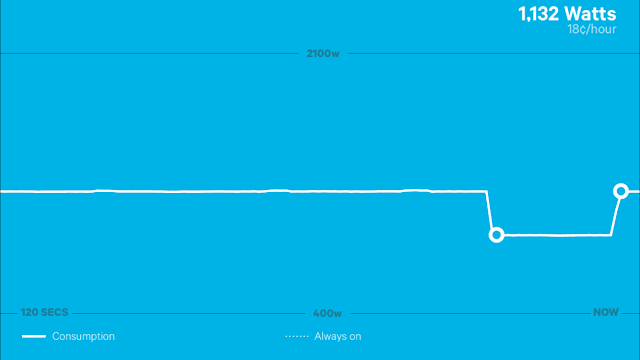
1,132 watts - 826 watts = 306 watts
306 watts / 5 lights = 61.2 watts per light

The Philips 248872 appears to be a comparable flood light. Its the same brand as the led and if you buy them in a case of 12 from Home Depot they are $2.33/ea ($27.97 for the case). You can find incandescent flood lights of the same wattage that cost MORE than comparable led lights. In this case I'd recommend buying the led light for its longer life and lower cost to run.

Neurio has a web interface and a mobile app that you can use to look at real-time and historic energy usage.
Here are the lights in our living room. One light, seen in the lower right, was burnt out when we moved into the house earlier this year.

To measure the consumption of the lights I got a baseline on the mobile app with the lights turned off,

and then turned them on,

This matches pretty closely with the 65 watt consumption label on one of the lights I checked.
Neurio also provides the cost per hour of your current energy consumption, based on the electric rate that you enter when configuring your account.
From the two energy graphs you can calculate that it costs $0.05/hr to run the lights in our living room.
What would it cost for a replacement led bulb, how much would it save compared to an incandescent and how long would it take to pay for itself?
I've had spotty luck with cheap compact florescent lights. The packaging claimed a great warranty and that it will last X thousand hours but I've had several of them burn out in a matter of a year or less. In one case I tried to contact the company for a replacement and I think the number was out of service.
I'd expect led lights to be a bit more reliable, simply because they are more efficient than the compact fluorescents. Heat is a cause of failures in electronic components, leds use less power so that should mean lower temperatures. Leds don't require the same kind of starter ballast but they do require an integrated ac/dc converter.
I found these leds on Amazon:

Philips is a widely known company. If they say they've got a warranty on a product its a pretty sure bet that they'll at least be around to deny your claim and not leave you with a disconnected phone number.
I thought that $4.50 a bulb was pretty expensive but searching on Amazon for any cheaper led flood lights didn't turn up anything cheaper, so we'll stick with the Philips for now.
We typically light our living room from 6-9:30pm, so approximately 3.5 hours per day. These led bulbs consume 9 watts of power, a savings of 56 watts per light, 280 watts for all 5 lights.

|

|
| Philips LED 462143 | Philips Incandescent 248872 |
| $4.50/ea | $2.33/ea |
| 9 watts | 65 watts |
| 650 lumens | 635 lumens |
| 10,000 hours estimated lifespan | 2,000 hours estimated lifespan |
The increased lifespan of the led makes it worth its extra cost. Even if the led only lasted half as many hours as expected, say 5,000 hours, you would have broken even on bulb cost and would have been saving energy the whole time. If the lifespan was 10,000 hours you would be saving several dollars over the incandescent bulb.
What if we look at energy savings alone? How long will it take for the led's lower energy consumption to offset its higher price?
$4.50 led - $2.33 incandescent = Led is $2.17 more expensive
Our living room used $0.05/hr with incandescent bulbs. Leds would consume:
9 watts * 5 lights = 45 watts with leds
45 watts led / 306 watts incandescent = 14.7%
14.7% of $0.05/hr = $0.0073/hr to run leds
Now we can calculate how long it will take to save the cost adder of the led bulb:
$2.17 / $0.0073/hr = ~300 hours
320 hours / 3hr/day = ~100 days
So after 100 days of using our living room lights 3 hours per day the electricity savings alone would pay for the increased cost of the led.
Based on these calculations switching to led bulbs makes sense. The leds would pay for themselves with electricity savings alone in a few months. If the lifespan estimates were even half of their advertised value you would break even just on the bulb cost. Looks like we'll be replacing our burnt out incandescent and compact fluorescent bulbs with leds.
This is extraordinary post thanks for sharing with us.
ReplyDeleteTop quality kitchen storage basket